Showing posts with label DDR. Show all posts

Saturday, November 28, 2020

Ch 4-2 Finding Heydekrug

1846 map Heidekrug

We finally reach the city she once called home. Roughly translated from the old German, Heydekrug can mean either heather land or inn.  Or it could be a derivation of a word for pagan – Heiden.  I’m going for the pagan idea. Lithuanians call it Silute. 

The city sits on the edge of the Memel River where the land changes from marshy to sandy.  On first impression it appears a pretty typical, central European city. The buildings and streets don’t offer any clues to its founding in 1511. I notice it lacks a traditional central marketplace. Later I discover the old marketplace on the edge of the old city, no longer in use. 

Buildings lining the main street are post office, grocery stores, local history museum, and a church. Don’t see any clothing stores, bakeries or houseware shops, standard in most German cities. It is all very well kept, as is much of what we have seen so far. 

Under German administration since 1815 Heydekrug was the seat of the county, called Kreis. Population now stands at 22,000 compared to 1925 when it was just over 4,000, but there was more population in the many surrounding small villages. None of the structures are older than one hundred years so young by European standards. So much was destroyed by a succession of wars and invaders – Teutonic Knights, Napoleon, various Kaisers, Czar Nicholas, Hitler, Stalin – all directing troops across this land as if it were a military playground.  This area's misfortune is to be positioned at a particularly volatile location between Germany and Russia. Lots of troops and settlers, back and forth, over the centuries.

The city is quite built up, stores on the side streets off the main thoroughfare. A very tall apartment building is visible to the south. Sunshine, blue sky and the world looks bright as shoppers bustle about. I honestly expected a bit of postwar Europe with some ruins, bricks and stucco falling off the buildings like old communist East Germany, but that’s not what I find. And Mom expected a 1945 war torn landscape.  In the ten years since the fall of the Communist empire, things changed quickly, probably more than in the previous forty years.  

On my first visit to the newly open eastern Germany, one year after the wall came down, the fresh, bright look to what had been run down was the most noticeable change. Previously the only color was a uniform, drab color I call Socialist grey.  It made life feel grey and dingy.  Another difference were bright accents in the landscaping: advertising! Didn't have that before. It wasn’t that inhabitants didn’t want their homes and businesses to look good – they just couldn’t purchase supplies to fix things up.  It took my East German Uncle years to construct a new entry foyer to their house. They had to wait for supplies to trickle in to stores then line up soon as word got out. While driving round the countryside they kept eyes open to check for supplies laying around that they could steal. Stolen goods were also useful to barter for other needed items. That was life in the workers’ paradise, the German Democratic Republic. If you showed the slightest discontent with the situation you were labeled a capitalist or maybe even a fascist – not sure which was worse.

We drive around by car, another sign of the times. Like America tourists with a lot of distance to cover, we’re used to viewing scenery from a car window, as if watching television.  Heydekrug is just a bit too big and spread out for us to walk the distances comfortably, most of it being new residential sprawl. The city was laid out along the main road which makes for a long city. We’ll get out of the car eventually, but the changes of the past 50 years seem minor in that it's very familiar to my mother. She finds her way around familiar landmarks like she is heading out on a lunch break from the grain cooperative where she worked. Mom does seem excited to see it all again, a good sign. I was apprehensive about what we’d find and how her reaction.

We drive into Heydekrug following the stream of traffic down the main street. Lots of shoppers crowd the sidewalks. People are dressed up and look very fit – probably because they do all this walking. Wonder how much this street scene changed in the last 10 years.

Is that a liveliness in their step as they walk down the street? They are not schlepping about humorless as in days where people avoided eye contact as in East Germany.  It is a lightness of being, if only reflecting hope for the future and the illusion of now having some control over one’s life.

Wednesday, November 25, 2020

Ch 2-3 On Our Way - Air Lithuania

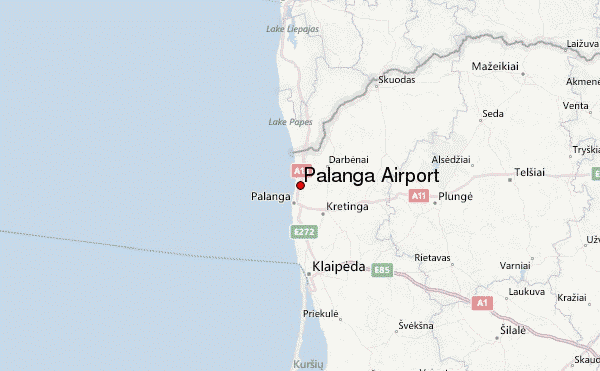
Was I ever in for a surprise. After some initial confusion at the gate as there were two flights leaving for Lithuania at the same time – one for the capital city Vilnius and the other for Palanga, things were fine. Once on board it turned into a truly pleasant flight.

After a short time in the air we are served a cold plate for dinner.  Lovely sandwiches made of hearty rye bread, smoked salmon and garnish.  And to sweeten the palate, a tasty candy made by Kraft Foods in Lithuania – somehow reassuring to know that capitalists already made inroads. For our beverage we get a beer.  It is simple.  It is delightful.  It tastes wonderful. The staff is attentive in a sort of throwback to what air travel was like years ago. The plane itself is an older American model evidenced by the English language warning signs and markings.

I had no idea what awaited us in Lithuania.   At least at this point in my life when traveling I have cash and charge cards so what problems can't be solved by money? This is a far cry from my student days where cash was tight and traveling cheap meant a lot of waiting for trains and hostels entry. No longer do we have to worry about being hauled off by the Stasi, or KGB, or whatever just because we are Americans, or do we?  Are remnants of the old guard lurking in doorways waiting to nab us innocents and hold us for ransom a warning as the U.S. Consulate in Germany warned me about the DDR. 

Anyway, just how bad could a place be that's on the internet?  Remember this is the early days of the net. It’s the first time I’ve used the internet for travel arrangements.  I did have to write the bed and breakfast for confirm our reservations, but I saw photos of the house online.  Amazing how quickly countries that didn't have personal telephone service became wired.

Mom worries about visiting the country she remembers from fifty-five years ago. It exists only in memories, a place where she never stayed in a hotel, owned a car or ate in restaurants.  Transport was by horse cart, foot, bike or train. She knows the stories about Germans who traveled back in recent years when it was still a Soviet satellite. They tell of poverty, desolation and the difficulty to secure any sort of transport.  Mentally she is prepared for scenes similar to what she experienced on her trips to East Germany years ago – a colorless socialist monolith; streets full of sullen, expressionless people; everyone cautious about what they said and who they spoke with.

Why didn’t we go to Lithuania years earlier when it was still communist?  We simply couldn’t.  On this side you’d end up with a knock on the door from the FBI, as happened to me after my first visit to East Germany.  Driving in East Germany on a visit I asked cousin Horst about the lack of road signs along the highway. He claimed it was intentional; the government figured locals knew where they had to go but they didn’t want to make things easy in case the country was invaded. Everyone knows invading East Germany was a high priority for the Americans, right? More likely it was due to a shortage of materials. Nor did our family have contacts in Lithuania. There were no family members left alive in East Prussia.

It would have been ever so much easier for us to take one of the tour groups originating out of Germany. There is a lot of interest in Germany among former inhabitants, like my mother, to go back and revisit their homeland.  But these tours only go to the major cities and our interest is out in the hinterlands. And I simply couldn’t stand being stuck with a group of elderly Germans for any length of time.  It might have been interesting to hear their tales of life back then, but the structure of a tour group would prove constrictive. So we will see it our way, at our pace, with Mom as tour guide.


Sunday, November 15, 2020

Ch 1-1 Why Do I want to Visit Lithuania?

I was but a wee child when dragged from my home on a snowy Christmas Eve.  But wait, this story is only indirectly about me; it’s actually about my mother, her family, their lives as recounted by my mother.  And my father, he does play a big role, but I learn about his family through my mother. So, because I am telling the story of my mother’s stories, this rather does end up being about me, the narrator. Am I the product of what came before me? In reality yes due to the facts that led to my mother and father ever meeting; but what is the role of ancestral connections.

Onward! The trip is fraught with minefields. For starters, I'm traveling with my mother. Previous trips proved no matter how you try, you can't get away from old patterns of behavior. Those old resentments, hurts and sensitivities bubble up.

So why should I subject myself to this? Blame it on the fall of Communism and the internet. Countries previously off limit are now open for travel. No convoluted visa requirements to maneuver! The world wide web opens up sources of info for accommodations, sights, roads, and more. It is now part of Lithuania which really isn't of immediate interest but I wanted to know about that long forgotten piece of land known once as Memelland, part of East Prussia. In World War II the fate of this land was decided as were the other German eastern provinces. The powers that won the war were entangled in brinkmanship with the Soviet Union, the preliminaries to the Cold War. Control was given to the Soviets.

This area along the northeast Baltic Sea, closer to Scandinavia than mainland Germany, had a very different geography in the centuries before 1945. The main city and port was Konigsberg, city of Immanuel Kant. It was a thriving province rich in food production for mainland Germany.  There evolved the myth of the Prussians, an exaggeration of their 'traits' for precision and militarism. After the war the East Prussian province was split in half between Poland and the Soviet Union, who kept access to a Baltic port that wasn’t frozen most of the year.  


Lithuania was wired to the internet in 2001. I could see the country, explore, make travel plans while sitting at my desktop computer. What I could not do online was actual see in 3D, smell and experience the places my mother knew. I needed to go in person but needed her as guide.

I did have first hand experience with the Iron Curtain places. I was born in East Germany, the second place my parents had to abandon their home and flee. In my college years I studied in West Germany and was finally able to visit relatives that in communist stronghold of the German Democratic Republic (DDR) – the East Zone as my parents referred to it. My mother visited when her father died but my father didn't go back until 1971. I saw firsthand the contradictions of life under communism: travel restrictions, economic problems, rampant black market, political hypocrisy and corruption. Family living there were my only uncle, his wife and my only male cousin - separated, locked behind the heavy curtain of a proclaimed paradise.  

In the old days, visiting the GDR was complicated. First the convoluted process of getting a visa; had to be very specific on dates of entry and exit. Once I entered the country I was required to register with the police and exchange the required amount of US Dollars for East German Marks. I could shop at the local west currency store but had to pay in west currency. I had a bunch of east marks and nothing worth buying that I could take it out of the country. The only people who went to the GDR were those with relatives and students from Africa; not sure if they even had tourists from other eastern Bloc countries.


Ch 8-3 Stories of School and Property

The land is sectioned into large farm collectives, a hallmark of the communist agricultural system. And before anyone could begin to farm, t...